7 Signs You May Need Braces: When Should You Visit a Dentist?
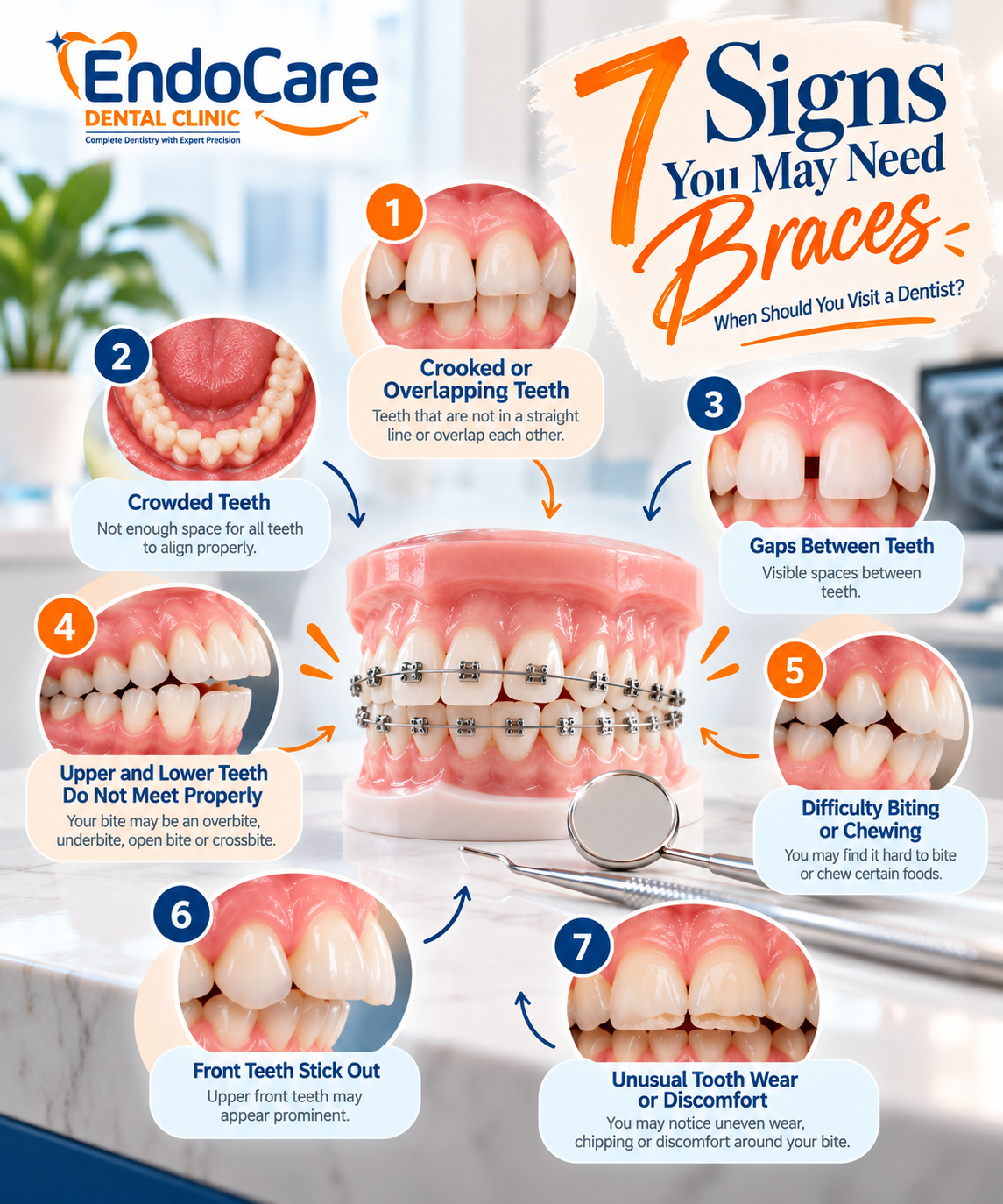
Have you ever wondered whether your teeth are crooked enough to need braces? Perhaps your front teeth overlap, there are visible gaps in your smile, or your upper and lower teeth do not meet comfortably when you bite.
Not every person with slightly misaligned teeth needs orthodontic treatment. However, certain signs may indicate that your tooth alignment or bite deserves professional assessment.
If you are searching for a dentist in Viman Nagar, Pune, understanding these signs can help you decide when to arrange a dental appointment.
At EndoCare Dental Clinic, Viman Nagar, patients can enquire about braces and clear aligner options following an individual assessment. Here are seven signs that may indicate you should have your teeth and bite evaluated.
1. Your Teeth Are Crooked or Overlapping
One of the most noticeable signs that you may benefit from an orthodontic assessment is crooked or overlapping teeth.
You might notice that:
-
One or more teeth rotate out of position.
-
Your front teeth overlap instead of following a relatively even line.
-
Certain teeth sit behind or in front of neighbouring teeth.
-
Your smile appears uneven because of tooth positioning.
Crooked teeth can occur because of differences in jaw size, tooth size, tooth eruption or other developmental factors.
Mild irregularities do not always require treatment. However, if your teeth are difficult to clean or the alignment affects your bite, an assessment can help determine whether orthodontic treatment may be useful.
2. Your Teeth Are Crowded
Dental crowding occurs when there is insufficient space for the teeth to align comfortably within the dental arch.
Crowded teeth may overlap, rotate or sit at unusual angles. Food and plaque can also be more difficult to remove from some crowded areas, making an effective oral hygiene routine particularly important.
How can you recognise crowded teeth?
Look for:
-
Teeth that overlap or appear compressed together.
-
Front teeth that are twisted or rotated.
-
Difficulty reaching certain surfaces while brushing or flossing.
-
Areas where food frequently gets trapped.
Crowding can range from mild to complex. Depending on the cause and severity, treatment planning may involve orthodontic tooth movement and, in selected cases, other procedures.
A dentist can assess the alignment and help you understand whether treatment is advisable.
3. You Have Noticeable Gaps Between Your Teeth
Gaps between teeth are another reason people consider braces or clear aligners.
Some gaps are naturally occurring and do not cause any functional problems. Others may be associated with differences in tooth size, missing teeth, the position of the teeth or other dental conditions.
Consider an assessment if you notice:
-
A prominent gap between your front teeth.
-
Spaces between several teeth.
-
Gaps that appear to be increasing.
-
Food frequently getting trapped between teeth.
A new or widening gap should not automatically be treated as an orthodontic problem. Gum disease, tooth movement and other dental issues can sometimes cause spaces to develop.
The cause should be assessed before deciding on treatment.
4. Your Upper and Lower Teeth Do Not Meet Properly
Your bite describes how your upper and lower teeth fit together when you close your mouth.
Certain bite differences may indicate that an orthodontic assessment is worthwhile.
Examples include:
-
Overbite: the upper front teeth overlap the lower front teeth vertically.
-
Deep bite: the vertical overlap is excessive.
-
Underbite: the lower front teeth sit in front of the upper front teeth.
-
Open bite: some upper and lower teeth do not meet when the mouth is closed.
-
Crossbite: one or more upper teeth bite inside the corresponding lower teeth.
The presence of a bite difference does not automatically mean you need braces. The significance depends on the severity, tooth and jaw relationships, and whether there are functional concerns.
If your teeth do not meet comfortably, a dental professional can assess the bite and discuss suitable options.
5. You Have Difficulty Biting or Chewing Certain Foods
Chewing difficulties can sometimes be related to tooth alignment or the way the upper and lower teeth meet.
You may notice that your front teeth do not come together properly when biting into food, or that your teeth seem to meet unevenly on one side.
Possible reasons include bite discrepancies, missing teeth, damaged teeth, dental pain or other oral health conditions.
Do not assume that chewing difficulty automatically means you need braces. Cavities, fractured teeth, gum problems and other conditions can also affect chewing.
If the difficulty persists, arrange a dental examination to identify the cause. Orthodontic treatment may be considered if tooth alignment or the bite contributes to the problem.
6. Your Front Teeth Stick Out
If your upper front teeth project noticeably forward, you may have increased overjet or another tooth-position or jaw relationship concern.
Overjet refers to the horizontal distance between the upper and lower front teeth. It differs from overbite, which describes their vertical overlap.
Prominent front teeth may be associated with differences in jaw development, tooth positioning or other factors.
Depending on the individual case, these teeth may be more vulnerable to accidental impact. An assessment can help establish whether orthodontic treatment is appropriate.
Treatment options depend on your age, the relationship between your jaws, the position of your teeth and your overall oral health.
7. You Notice Unusual Tooth Wear or Discomfort Around Your Bite
Some bite problems can contribute to uneven tooth wear, repeated contact between particular teeth or irritation of the gums.
You may notice:
-
Teeth that appear worn down unevenly.
-
Repeated chipping or damage to certain teeth.
-
Lower front teeth contacting the gum tissue behind the upper front teeth.
-
A bite that feels uncomfortable or different from before.
These signs do not necessarily mean braces are the solution. Tooth grinding, damaged restorations, gum problems and other conditions may cause similar symptoms.
A dental examination can help identify the underlying issue and determine whether orthodontic assessment should form part of your care.
If your bite changes suddenly, or you experience significant pain or swelling, seek prompt dental advice.
Do You Always Need Braces If Your Teeth Are Crooked?
No. Slightly crooked teeth, small gaps or minor bite differences do not automatically require orthodontic treatment.
A dentist or orthodontic professional considers several factors before recommending braces or another approach, including:
-
The degree of tooth misalignment.
-
Whether the upper and lower teeth meet properly.
-
Your ability to maintain oral hygiene.
-
Any tooth wear, gum trauma or functional difficulties.
-
The health of your teeth and gums.
-
Your treatment goals and expectations.
Some people may benefit from orthodontic treatment, while others may simply need monitoring or management of a separate dental problem.
The aim is to establish what is happening and whether treatment would provide a meaningful benefit—not to recommend braces solely because teeth are not perfectly straight.
At What Age Should You Get Braces?
Orthodontic assessment is not limited to teenagers.
Children
An early orthodontic assessment can help identify developing bite or alignment problems. The appropriate timing of treatment depends on the child's dental development and the nature of the problem.
An early visit does not mean braces must be fitted immediately.
Teenagers
Many orthodontic treatments are undertaken during the teenage years, when most permanent teeth have erupted. However, the right timing varies from person to person.
Adults
Adults can also undergo orthodontic treatment. The condition of the teeth and gums, existing restorations, bone support and the complexity of the bite all influence treatment planning.
If you are an adult considering braces in Viman Nagar, Pune, a dental assessment can help clarify your options.
What Happens During an Orthodontic Assessment?
If you suspect that you may need braces, the first step is to have your teeth and bite examined.
Depending on your needs, the assessment may include:
-
Dental examination: The clinician evaluates your teeth, gums and general oral health.
-
Bite assessment: The relationship between the upper and lower teeth is examined.
-
Diagnostic records: Photographs, digital scans or X-rays may be recommended when clinically indicated.
-
Treatment discussion: The findings are explained, along with suitable options and their limitations.
-
Personalised plan: If treatment is appropriate, the clinician discusses the proposed approach, expected duration and follow-up requirements.
Not every patient requires every diagnostic procedure. These are selected according to the clinical findings.
Braces or Clear Aligners: What Happens Next?
Once the bite and tooth alignment have been assessed, suitable treatment options can be discussed.
Braces use brackets and wires to move teeth. Clear aligners use a series of removable trays to produce planned tooth movements.
Neither option is ideal for every case. Suitability depends on the movements required, the complexity of the bite, oral health and the patient's ability to follow the treatment plan.
For more information, read our related guide: Invisible Aligners vs Braces: Which Is Better?
Choosing a treatment should follow an assessment rather than relying only on photographs or comparisons online.
Looking for a Dentist in Viman Nagar, Pune?
If you have noticed crowded teeth, gaps, prominent front teeth or an uncomfortable bite, consider arranging a dental assessment to understand the cause.
EndoCare Dental Clinic is a multispeciality dental clinic in Viman Nagar, Pune, led by Dr. Mugdha Bichile Pimplapure, BDS, MDS, with 9+ years of clinical experience.
Patients can enquire about braces and clear aligner options, along with other dental services. Recommendations are based on the individual's clinical needs and treatment plan.
The clinic is conveniently located for patients travelling from Viman Nagar and nearby areas, including Kalyani Nagar, Wadgaon Sheri, Kharadi and Dhanori.
EndoCare Dental Clinic
Near Datta Mandir Chowk, Parijat Mithai Building, 1st Floor, Sai Apex, Viman Nagar Road, Pune, Maharashtra 411014.
Phone: +91 90968 82602
Hours: Open all seven days, 10:00 AM–9:00 PM.
Concerned about your tooth alignment? Contact EndoCare Dental Clinic to enquire about a dental assessment.
Frequently Asked Questions
1. How do I know if I need braces?
Crooked or crowded teeth, noticeable gaps, certain bite problems and difficulty biting or chewing may indicate that an orthodontic assessment would be useful. Only an examination can determine whether braces are appropriate.
2. Can I need braces even if my teeth look straight?
Yes. Some bite problems are not obvious when you look at your teeth in a mirror. A dental professional can assess how your upper and lower teeth meet.
3. Can adults get braces?
Yes. Adults can undergo orthodontic treatment if their oral health and clinical circumstances permit it. Treatment planning takes account of gum health, tooth condition, bite relationships and individual goals.
4. Do crowded teeth always need braces?
No. The need for treatment depends on the severity of crowding, its effect on oral hygiene and function, and the patient's circumstances. Some cases can be monitored, while others may benefit from orthodontic treatment.
5. Are braces necessary for an overbite?
Not every overbite requires treatment. A normal amount of vertical overlap is expected. Treatment may be considered when the overlap is excessive or contributes to tooth wear, gum trauma or functional problems.
6. Should children have their teeth checked for braces early?
An early orthodontic assessment can identify developing alignment or bite concerns. The clinician can advise whether treatment is needed now, later or not at all.
7. Where can I enquire about braces in Viman Nagar, Pune?
You can contact EndoCare Dental Clinic in Viman Nagar, Pune, to enquire about an assessment and available orthodontic options. The appropriate treatment will depend on your individual examination.
Conclusion
Crooked teeth, crowding, gaps, prominent front teeth and certain bite problems are all reasons to consider an orthodontic assessment. However, these signs do not automatically mean that braces are necessary.
Understanding the cause of the problem is the first step towards deciding whether treatment may help.
If you are concerned about your tooth alignment, contact EndoCare Dental Clinic in Viman Nagar, Pune, to discuss your concerns and arrange an assessment.
EndoCare Dental Clinic — Complete Dentistry with Expert Precision.
Medical disclaimer: This article provides general educational information and does not replace an individual dental examination or personalised treatment advice.
This article is general information from the EndoCare Dental Clinic team. It is not a diagnosis or a substitute for an examination by your dentist. Please consult a dentist for advice about your own teeth.