Invisible Aligners vs Braces: Which Is Better? | EndoCare Dental Clinic, VIman Nagar Pune
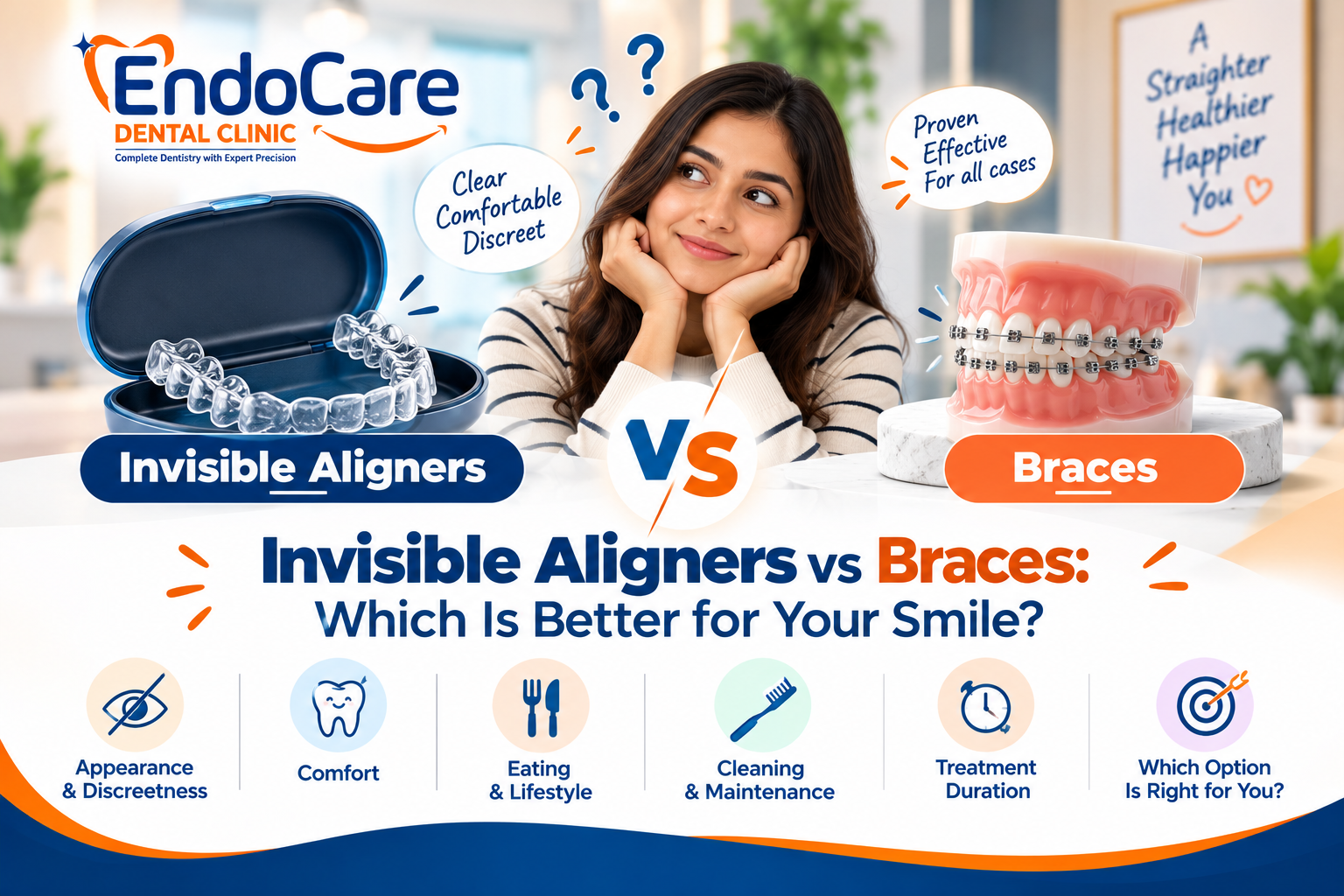
Invisible Aligners vs Braces: Which Is Better for Your Smile?
Thinking about straightening your teeth but unsure whether to choose invisible aligners or traditional braces? You are not alone. Many people want a straighter smile while also considering appearance, comfort, convenience, cleaning and the demands of everyday life.
Both invisible aligners and braces are orthodontic treatments designed to move teeth into more favourable positions. However, they work differently, and the right option depends on your teeth, bite, treatment goals and ability to follow the treatment plan.
If you are comparing invisible aligners vs braces in Viman Nagar, Pune, this guide explains the key differences so you can have a more informed discussion with your dentist or orthodontist.
In This Article
-
What are invisible aligners?
-
What are traditional braces?
-
Invisible aligners vs braces: key differences
-
Which option is suitable for you?
-
Treatment duration and daily care
-
What happens during an orthodontic consultation?
-
Frequently asked questions
What Are Invisible Aligners?
Invisible aligners, also called clear aligners, are custom-made, transparent trays that fit over your teeth. A planned series of trays gradually moves the teeth towards their intended positions.
Unlike fixed braces, aligners can be removed for eating, drinking most beverages other than water, brushing and flossing. They are generally worn for most of the day, according to the treatment plan prescribed by the treating dental professional.
Benefits of invisible aligners
1. A discreet appearance
Clear aligners are less noticeable than many traditional braces, which can appeal to adults and teenagers who prefer a subtle orthodontic option.
2. Removable for meals
You can remove aligners for meals and snacks, so there are generally fewer food restrictions related to the appliance itself.
3. Easier routine brushing and flossing
Because aligners are removable, you can brush and clean between your teeth without working around fixed brackets and wires.
4. Fewer appliance-related food concerns
You do not have to avoid foods specifically because they might break a fixed bracket. You must still remove, clean and store your aligners as instructed.
What should you consider before choosing aligners?
Aligners require commitment. They need to be worn for the prescribed number of hours each day and changed according to the treatment schedule.
Frequent removal or inconsistent wear can interfere with progress. You must also clean your teeth before putting the trays back in and keep the aligners clean.
Clear aligners are not suitable for every orthodontic problem. An examination is needed to determine whether they can achieve your treatment goals safely and predictably.
What Are Traditional Braces?
Traditional braces use brackets attached to the teeth and a wire that applies controlled forces to move the teeth over time. Your dental professional adjusts or monitors the appliance during scheduled visits.
Braces may be metal or tooth-coloured, depending on the option selected and what is available for your treatment.
Benefits of traditional braces
1. They remain in place
Because braces are fixed to your teeth, you do not have to remember to put them back after meals.
2. They can address a wide range of orthodontic problems
Fixed braces can be useful for many alignment and bite concerns, including cases that may be unsuitable for aligners alone. The best approach depends on the complexity of the individual case.
3. They do not depend on remembering to wear trays
Braces continue applying forces as planned without requiring the patient to remove and reinsert an appliance throughout the day.
4. Different options may be available
Depending on the clinical situation, your dental professional may discuss metal or tooth-coloured braces.
What should you consider before choosing braces?
Brackets and wires can trap food and make brushing and cleaning between teeth more challenging. Careful oral hygiene is essential throughout treatment.
You may need to avoid certain hard, sticky or chewy foods that could damage the appliance. Some patients also experience temporary soreness after placement or adjustments.
Regular appointments are important to monitor progress and make necessary adjustments.
Invisible Aligners vs Braces: Key Differences
| Feature | Invisible aligners | Traditional braces |
|---|---|---|
| Appearance | Transparent and generally less noticeable | Metal or tooth-coloured brackets and wires |
| Removable | Yes, as directed by your clinician | No, fixed to the teeth |
| Eating | Remove for meals and snacks | Some hard, sticky and chewy foods may need to be avoided |
| Brushing and flossing | Easier to access teeth after removing trays | Requires careful cleaning around brackets and wires |
| Daily commitment | Must be worn for the prescribed hours | Remain fixed in place |
| Follow-up | Progress checks and aligner changes as prescribed | Regular checks and adjustments |
| Suitability | Depends on the alignment problem and treatment plan | Can address a wide range of orthodontic problems |
| Main challenge | Remembering to wear and care for the trays | Maintaining oral hygiene and adapting to a fixed appliance |
Which one is better? Neither option is automatically best for everyone. The decision depends on the diagnosis, the movements required, your lifestyle and your ability to follow the treatment plan.
The American Dental Association explains that both braces and professionally supervised removable aligners can be used to correct orthodontic problems, with treatment selection depending on the individual's needs and the dental professional's assessment.
Which Option Is Suitable for You?
1. If appearance is your main concern
If you want a less noticeable appliance, clear aligners may be worth discussing with your dentist.
However, appearance should not be the only consideration. Your bite, tooth positions, gum health and treatment goals must also be assessed.
2. If you prefer not to manage a removable appliance
Traditional braces may suit people who would rather not remember to remove, clean and reinsert trays throughout the day.
Aligners can work well only when worn as prescribed, so be realistic about your daily routine before deciding.
3. If your teeth are significantly crowded or your bite is complicated
Some complex tooth movements or bite problems may be better managed with fixed braces or another carefully planned orthodontic approach. Other cases may still be treatable with clear aligners under professional supervision.
The severity of the problem alone does not determine the answer. An orthodontic assessment is needed to establish which options can achieve the intended result.
4. If you want easier brushing and flossing
Removable aligners allow you to clean your teeth without working around brackets and wires. However, the trays themselves also need regular cleaning, and you should brush your teeth before reinserting them.
With braces, careful brushing around every bracket and cleaning between the teeth are particularly important.
5. If you have a busy schedule
Consider the practical demands of each option. Aligners require consistent wear and care, while braces require attention to food choices and cleaning around the appliance.
Both treatments involve follow-up appointments. Ask your dental professional what your expected visits and daily responsibilities will look like before committing.
6. If you are choosing treatment for a teenager
Consider the teenager's orthodontic needs, maturity, daily routine and ability to follow instructions. Removable aligners require consistent wear, while fixed braces require careful cleaning and attention to food restrictions.
A parent, teenager and treating dental professional can discuss the advantages and responsibilities of each option before deciding.
Do Invisible Aligners Work Faster Than Braces?
There is no single treatment duration that applies to everyone.
The time required depends on the complexity of the alignment problem, the movements needed, the chosen appliance, biological response and how consistently the treatment plan is followed.
Some cases may be completed in a shorter period than others, but it would be misleading to promise that aligners are always faster than braces—or that braces are always faster than aligners.
Ask your dental professional for an estimate based on your examination and proposed treatment plan. Remember that the estimated duration may change as your teeth respond to treatment.
Do Invisible Aligners Hurt Less Than Braces?
Both options can cause temporary pressure, tenderness or discomfort as the teeth begin to move.
With aligners, you may notice pressure when starting a new tray. With braces, discomfort can occur after placement or adjustment, and brackets or wires may sometimes irritate the inside of the cheeks or lips.
The experience varies from person to person. Persistent, severe or unexpected pain should be discussed with your treating dental professional rather than ignored.
What Happens During an Orthodontic Consultation?
Before recommending aligners or braces, your dental professional needs to understand your oral health and treatment goals.
An orthodontic consultation may include:
-
Discussing your concerns: What would you like to change about your smile, bite or tooth alignment?
-
Examining your teeth and gums: The clinician checks tooth positions, bite relationships and oral health.
-
Reviewing diagnostic records: Photographs, dental scans, impressions or X-rays may be recommended when clinically indicated.
-
Discussing treatment options: Your clinician explains which options are appropriate, along with their advantages and limitations.
-
Planning follow-up care: You discuss expected visits, oral hygiene, retention after treatment and the estimated treatment duration.
Do not choose a treatment solely because of an online advertisement or a photograph of someone else's smile. A professional assessment is important before starting orthodontic treatment.
Avoid attempting to straighten teeth using unsupervised, mail-order or do-it-yourself methods. Teeth and bite relationships need proper evaluation and monitoring during orthodontic movement.
How Can You Maintain Oral Hygiene During Treatment?
Good oral hygiene matters whether you choose aligners or braces.
If you choose invisible aligners
-
Brush your teeth before reinserting your trays.
-
Clean the aligners according to your clinician's instructions.
-
Remove the trays for meals and for drinks other than water, as directed.
-
Store the trays safely in their case when they are not being worn.
-
Attend your scheduled progress checks.
If you choose braces
-
Brush carefully around each bracket and along the gumline.
-
Clean between the teeth using an appropriate interdental aid.
-
Follow your clinician's advice about foods that may damage the appliance.
-
Contact the dental clinic if a wire or bracket becomes loose or causes persistent irritation.
-
Attend scheduled adjustment and monitoring appointments.
Whichever treatment you choose, ask your dental professional to demonstrate the correct cleaning technique for your appliance.
Invisible Aligners and Braces in Viman Nagar, Pune
If you are exploring orthodontic treatment in Viman Nagar, Pune, the first step is to find out which options are suitable for your teeth and bite.
At EndoCare Dental Clinic, patients can enquire about braces and aligner options and discuss their dental concerns during a consultation. The appropriate treatment depends on an individual examination and a personalised treatment plan.
Patients visit the Viman Nagar clinic from nearby areas, including Kalyani Nagar, Wadgaon Sheri, Kharadi and Dhanori. These are nearby service areas served by the Viman Nagar clinic, not separate EndoCare branches.
Book an orthodontic consultation
EndoCare Dental Clinic
Near Datta Mandir Chowk, Parijat Mithai Building, 1st Floor, Sai Apex, Viman Nagar Road, Viman Nagar, Pune, Maharashtra 411014
Phone: +91 90968 82602
Hours: Open all seven days, 10:00 AM–9:00 PM
Contact the clinic to discuss your concerns and arrange an assessment.
Frequently Asked Questions
1. Are invisible aligners better than braces?
Not for everyone. Aligners may appeal to people who prefer a discreet, removable appliance, while braces can be suitable for a wide range of orthodontic problems. The best option depends on your teeth, bite and treatment goals.
2. Can invisible aligners fix crooked teeth?
Clear aligners can correct many types of tooth misalignment, but they are not appropriate for every case. A dental professional needs to assess your teeth and determine whether aligners can achieve the intended movements.
3. Are braces more effective than invisible aligners?
Neither is universally more effective. Both can work well when appropriately selected and managed. The result depends on the orthodontic problem, treatment planning and adherence to the prescribed plan.
4. Can I eat with invisible aligners?
Generally, aligners should be removed for meals and for drinks other than water, according to your clinician's instructions. Clean your teeth before putting them back in.
5. Do I need retainers after aligners or braces?
Retainers are commonly recommended after orthodontic treatment to help maintain the new tooth positions. Your dental professional will advise on the type of retainer and the wearing schedule appropriate for your case.
6. Can adults choose braces or invisible aligners?
Yes. Orthodontic treatment can be considered by adults as well as younger patients, provided their oral health and clinical circumstances are suitable. A dental assessment helps determine the available options.
7. How do I choose between aligners and braces in Viman Nagar, Pune?
Arrange a consultation with a dental professional who can assess your teeth, bite, oral health and treatment goals. Ask about the suitable options, expected duration, daily responsibilities, follow-up visits and retention after treatment.
Conclusion: Choose the Treatment That Fits Your Smile
Invisible aligners and traditional braces can both help improve tooth alignment, but they involve different responsibilities and are not interchangeable in every case.
Aligners offer a discreet, removable option for suitable patients who can follow the prescribed wearing schedule. Braces remain fixed in place and can be appropriate for a wide range of orthodontic problems.
The best decision starts with an examination, a clear understanding of your treatment options and a plan that fits your clinical needs and daily routine.
If you are considering invisible aligners or braces in Viman Nagar, Pune, contact EndoCare Dental Clinic to discuss your options and arrange a consultation.
EndoCare Dental Clinic | Complete Dentistry with Expert Precision
Medical disclaimer: This article is for general educational purposes and does not replace an individual dental examination, diagnosis or personalised orthodontic treatment plan.
This article is general information from the EndoCare Dental Clinic team. It is not a diagnosis or a substitute for an examination by your dentist. Please consult a dentist for advice about your own teeth.