Dental Floss vs Water Flosser | EndoCare Dental Clinic, Viman Nagar Pune
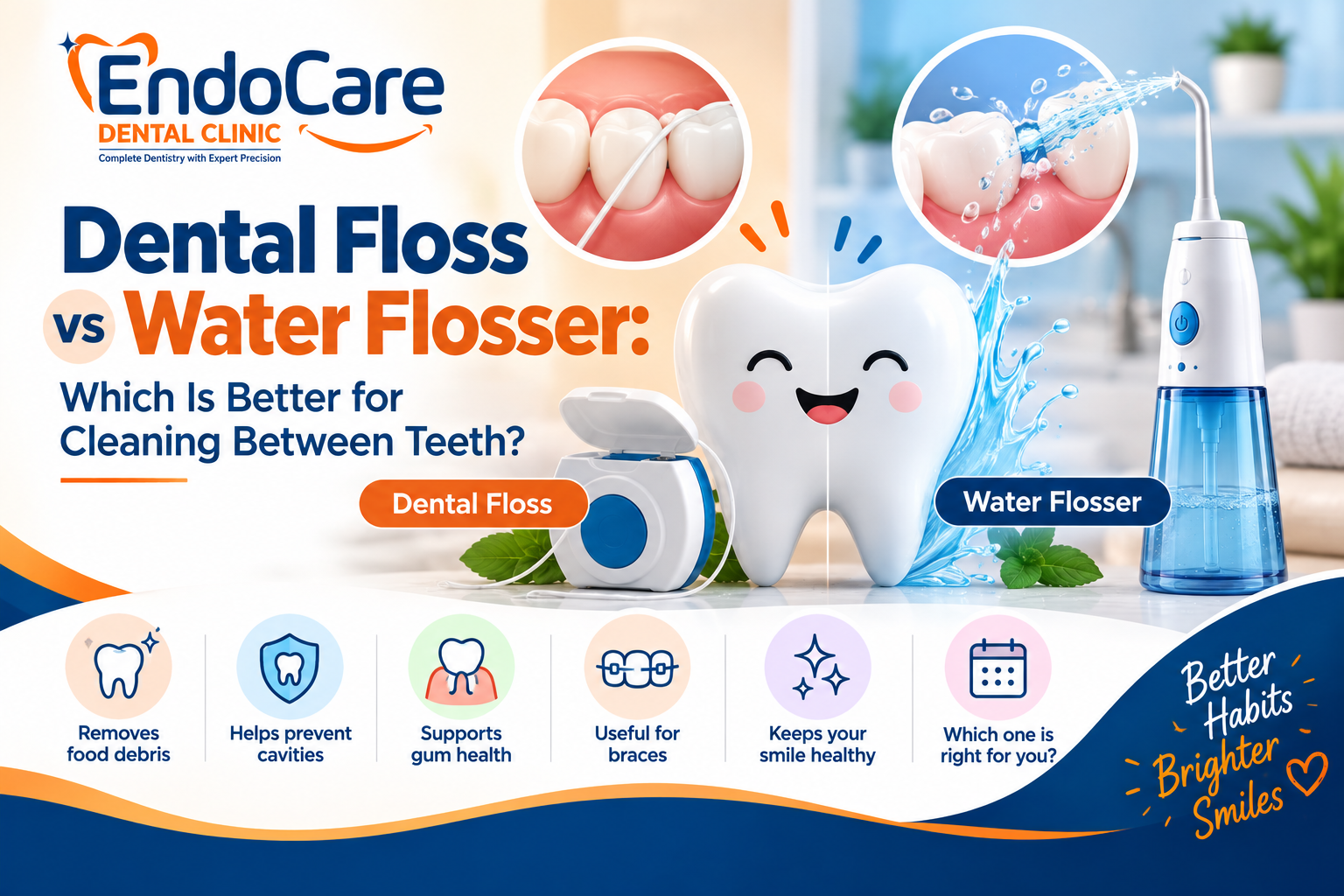
Dental Floss vs Water Flosser: Which Is Better for Cleaning Between Teeth?
Brushing twice a day is an important part of maintaining healthy teeth, but your toothbrush cannot effectively reach every surface between your teeth.
That is where interdental cleaning comes in. Traditional dental floss and electric water flossers are two popular options for removing food debris and helping control plaque in these difficult-to-reach areas.
But which is better: dental floss or a water flosser?
Is traditional floss enough? Can a water flosser replace it? Is a water flosser useful if you wear braces or have sensitive gums?
The answer depends on your individual dental needs, the spaces between your teeth and which method you can use correctly and consistently. The American Dental Association recognises floss and other interdental cleaners, including water flossers, as options for cleaning between teeth. American Dental Association
In this guide, we compare the two methods, explain how to use them and help you understand when professional advice may be useful.
In This Article
- Why cleaning between your teeth matters
- What traditional dental floss does
- What a water flosser does
- Dental floss vs water flosser: key differences
- Which option suits different dental needs?
- How to use each method correctly
- Common mistakes to avoid
- Frequently asked questions
Why Cleaning Between Your Teeth Matters
Your teeth have several surfaces, including the areas that face neighbouring teeth. These contact areas can trap food debris and allow plaque to accumulate.
Plaque is a sticky film containing bacteria that forms on teeth. If it is not removed regularly, it can contribute to tooth decay and gum inflammation.
Over time, plaque can also harden into tartar. Once tartar has formed, brushing and home interdental cleaning cannot reliably remove it; professional dental cleaning is needed. American Dental Association
Cleaning between your teeth helps you reach areas that an ordinary toothbrush may miss.
Daily interdental cleaning can be particularly important if you have:
- Teeth that touch closely together.
- Food that frequently becomes trapped between teeth.
- Braces or other orthodontic appliances.
- Gum recession or spaces between teeth.
- Dental restorations that require additional cleaning.
- Difficulty maintaining a consistent oral-hygiene routine.
The right method varies from person to person. Your dentist can help you choose a suitable tool and demonstrate how to use it safely.
What Is Traditional Dental Floss?
Dental floss is a thin strand or tape designed to clean between teeth and around the gumline.
It is particularly useful for reaching narrow spaces where an interdental brush may not fit.
Benefits of traditional dental floss
1. It reaches tight spaces
Floss can slide between closely positioned teeth and help remove plaque from the sides of neighbouring teeth.
2. It is compact and portable
A small floss container or floss holder can easily be carried in a bag or kept at work.
3. It does not require electricity
Traditional floss can be used without charging a device or filling a water reservoir.
4. It can be inexpensive and simple to maintain
There are no electronic components or water tanks to clean.
What are its limitations?
Traditional floss requires some manual dexterity and correct technique.
If you find it difficult to guide the floss around the backs of your teeth, have limited hand movement or struggle to use it consistently, another interdental cleaning method may be more practical.
Floss should also be used gently. Forcing it into the gums or snapping it down between teeth can cause discomfort or injury.
The aim is to clean the tooth surfaces, not to cut into the gum tissue.
What Is a Water Flosser?
A water flosser is an electronic device that directs a controlled stream of water between teeth and along the gumline.
Depending on the model, it may have different pressure settings and interchangeable tips.
Water flossers can be useful for people who find traditional floss difficult to handle. They may also make cleaning around orthodontic appliances more convenient.
Benefits of a water flosser
1. It can be easier to handle
Some people find directing a water-flossing tip more comfortable than manipulating a strand of floss between their fingers.
2. It can help clean around braces
Brackets and orthodontic wires create additional surfaces where food debris can accumulate. A water flosser may help flush debris from these areas.
3. It can be useful around some dental restorations
Depending on the restoration and the person's needs, a water flosser may help clean around bridges and other dental work.
Your dentist can advise whether a particular tip or additional cleaning tool is needed.
4. It offers an alternative for people who struggle with traditional floss
If manual dexterity or the technique required for flossing is a barrier, a water flosser may make daily interdental cleaning easier to maintain.
What are its limitations?
A water flosser needs a power source or charged battery, water and regular cleaning of the device.
It can also take practice to direct the water around all the teeth without splashing.
Most importantly, a water flosser does not automatically replace every other cleaning method for every person. Some people may benefit from floss, interdental brushes or a combination of tools.
The best choice depends on your mouth and how effectively you can use the method. American Dental Association
Dental Floss vs Water Flosser: Key Differences
| Feature | Traditional dental floss | Water flosser |
|---|---|---|
| How it works | A strand or tape cleans the sides of teeth | A stream of water cleans between teeth and along the gumline |
| Tight spaces | Often useful when teeth are closely positioned | Can help flush debris, but may not provide the same contact-surface cleaning for every person |
| Braces | Can be used with appropriate technique or flossing aids | May make cleaning around brackets and wires more convenient |
| Manual dexterity | Requires control of the floss | May be easier for some people to handle |
| Portability | Usually very portable | Depends on the device and its battery or power requirements |
| Maintenance | Replace the floss after use | Clean the reservoir and tip according to the manufacturer's instructions |
| Best choice | Depends on spacing, technique and individual needs | Depends on spacing, technique and individual needs |
So, which one wins?
Neither is universally best for everyone. Traditional floss can be very useful for tight spaces, while a water flosser can be a convenient alternative or addition for people who struggle with manual flossing or need help cleaning around appliances.
For some people, an appropriately sized interdental brush may be more suitable than either option. Your dentist can recommend the best approach for your teeth and gums. American Dental Association
Which Option Is Better for Different Dental Needs?
1. If your teeth are closely positioned
Traditional floss may be a practical option because it can reach between tightly contacting teeth.
Guide it gently between the teeth and curve it around each tooth surface. Do not force it through a tight contact.
If floss repeatedly shreds, catches or causes pain, ask your dentist to check the area rather than continuing to force it through.
2. If you wear braces
Braces can make cleaning more challenging because food and plaque may accumulate around brackets and wires.
A water flosser may help flush away loose debris and make the routine more manageable.
However, it should not be treated as a complete substitute for brushing around brackets and cleaning between the teeth. Depending on your orthodontic appliance and spacing, your dentist may recommend floss threaders, orthodontic floss, interdental brushes or a combination of methods.
For more information about orthodontic care, explore Invisible Aligners & Braces at EndoCare.
3. If you have gum inflammation
Bleeding gums can occur when plaque accumulates around the gumline, although bleeding can have other causes.
Gentle, regular cleaning between the teeth is important, but switching devices alone may not address the underlying problem.
If your gums bleed persistently, appear swollen or feel tender, arrange a dental assessment. Your dentist can determine whether you need improved cleaning technique, professional cleaning or specific gum treatment.
Learn more about Gum Treatment in Viman Nagar, Pune.
4. If you have dental bridges or other restorations
Dental bridges and certain restorations may have areas underneath or around them that need special cleaning.
Traditional floss may require a threader or another appropriate aid to reach some areas. A water flosser may also be useful, depending on the design of the restoration.
Do not assume that one tool is suitable for every bridge, crown or implant. Ask your dentist to demonstrate the correct cleaning method for your specific dental work.
5. If you have limited hand movement
Traditional floss can be difficult to manage for some people.
A water flosser, floss holder or another adapted interdental cleaner may make daily cleaning easier.
The most useful option is one that lets you clean effectively without hurting your gums and that you can realistically use every day.
6. If food frequently gets trapped between your teeth
Repeated food trapping may relate to tooth spacing, the shape of the contact between teeth, gum changes, a restoration or another dental issue.
A water flosser may help remove loose debris, while floss or an appropriately sized interdental brush may help clean the affected surfaces.
If food repeatedly gets trapped in the same place, arrange a dental examination to identify the cause rather than relying only on a cleaning device.
How to Use Dental Floss Correctly
Using floss gently and methodically helps clean the tooth surfaces without unnecessarily irritating your gums.
Step 1: Use a manageable length
Take a suitable length of floss and wind most of it around the middle fingers of both hands, leaving a short section to work with.
Hold it securely between your thumbs and index fingers.
Step 2: Guide it gently between the teeth
Use a controlled, gentle movement to pass the floss through the contact between two teeth.
Do not snap it forcefully into the gums.
Step 3: Curve the floss around one tooth
Form a C-shape around the side of one tooth and move the floss gently up and down along the tooth surface, extending slightly beneath the gumline where it fits comfortably.
Step 4: Clean the neighbouring tooth
Repeat the movement against the adjacent tooth surface rather than cleaning only the gap between the teeth.
Step 5: Move to a clean section
Work systematically around the mouth and use a clean section of floss as you move between areas.
Dispose of used floss after use.
If you are unsure about the technique, ask your dentist to demonstrate it. The American Dental Association's guide to floss and interdental cleaners provides additional oral-hygiene information.
How to Use a Water Flosser Correctly
Water flossers can be helpful, but correct positioning and consistent use matter.
Step 1: Fill the reservoir
Fill the water reservoir according to the manufacturer's instructions. Check that the tip is fitted correctly before switching the device on.
Step 2: Start with a comfortable setting
If you are new to water flossing, begin with a lower pressure setting and adjust only as comfortable and appropriate for the device.
High pressure is not a substitute for correct technique.
Step 3: Lean over the sink
Position yourself so that the water can drain into the sink. Place the tip in your mouth before switching on the water flow, following the device instructions.
Step 4: Trace the gumline
Guide the tip methodically along the gumline and between the teeth, pausing briefly where appropriate.
Follow the manufacturer's instructions for tip positioning and cleaning around orthodontic appliances or restorations.
Step 5: Clean all areas
Work around the entire mouth, including the back teeth. Avoid concentrating only on the areas where food is most noticeable.
Step 6: Clean and store the device
Empty or clean the reservoir as instructed. Maintain the tip and other components according to the manufacturer's guidance.
If you experience persistent pain or bleeding, ask your dentist to assess the cause and check your technique.
Common Interdental Cleaning Mistakes
Even a good cleaning tool may be ineffective if it is used incorrectly.
Mistake 1: Thinking brushing alone is always enough
A toothbrush cannot reliably clean every tight space between teeth. Daily interdental cleaning helps reach these areas. nhs.uk
Mistake 2: Using floss too aggressively
Snapping floss into the gums can cause injury. Use gentle, controlled movements.
Mistake 3: Using excessive water pressure
A stronger setting does not necessarily mean better cleaning. Choose a comfortable setting and follow the device instructions.
Mistake 4: Ignoring the back teeth
The back teeth can be more difficult to reach, but they still need careful cleaning.
Mistake 5: Assuming a water flosser removes tartar
A water flosser can help remove loose debris and support plaque control, but it cannot reliably remove hardened tartar. Tartar may require professional scaling.
You can learn more about professional cleaning through Teeth Cleaning & Scaling at EndoCare.
Mistake 6: Ignoring persistent gum bleeding
Bleeding should not automatically be dismissed as normal. If it persists or recurs, arrange an examination to determine whether gum inflammation or another condition is responsible.
Mistake 7: Choosing a device without considering your teeth
The best tool depends on the spaces between your teeth, your gum health, any orthodontic appliances or restorations, and your ability to use the device safely.
A dentist can help you select an appropriate method rather than relying on advertising claims alone.
When Should You Ask a Dentist for Advice?
Consider arranging a dental consultation if:
- Your gums bleed repeatedly when brushing or cleaning between teeth.
- Food becomes trapped in the same area regularly.
- Floss catches, shreds or causes persistent discomfort.
- You have braces, bridges or other restorations that are difficult to clean.
- Your gums appear swollen or have receded.
- You are unsure whether floss, an interdental brush or a water flosser is most appropriate.
- You have difficulty maintaining your oral-hygiene routine.
Your dentist can examine your teeth and gums, identify areas that need special attention and demonstrate a suitable cleaning technique.
If hardened tartar has accumulated, professional cleaning may be necessary. A home device cannot replace a dental examination or treatment when a problem requires professional care.
Dental Care in Viman Nagar, Pune
Choosing the right interdental cleaning method is an important part of maintaining oral health. If you are unsure which device is suitable for you, a dental consultation can help you understand your individual needs.
At EndoCare Dental Clinic in Viman Nagar, Pune, patients can seek guidance about routine dental care, professional cleaning, gum health and orthodontic treatment.
The clinic serves patients from Viman Nagar and nearby areas, including Kalyani Nagar, Wadgaon Sheri, Kharadi and Dhanori. These are nearby service areas served by the Viman Nagar clinic, not separate EndoCare branches.
Book a dental consultation
EndoCare Dental Clinic
Near Datta Mandir Chowk, Parijat Mithai Building, 1st Floor, Sai Apex, Viman Nagar Road, Viman Nagar, Pune, Maharashtra 411014
Phone: +91 90968 82602
Hours: Open all seven days, 10:00 AM–9:00 PM
To discuss your oral-hygiene concerns or request an appointment, visit the EndoCare Contact and Appointments page.
Frequently Asked Questions
1. Is a water flosser better than traditional dental floss?
Not for everyone. Traditional floss can be useful for cleaning tight spaces, while a water flosser may be easier for some people to use, especially around braces or when manual dexterity is limited. The most suitable method depends on your teeth, gums and cleaning needs. American Dental Association
2. Can a water flosser replace dental floss completely?
A water flosser may be a suitable interdental cleaning option for some people, but it is not automatically the best replacement for traditional floss in every situation. Your dentist can advise whether you should use a water flosser alone or combine it with floss or an interdental brush.
3. Is a water flosser useful for people wearing braces?
It may be useful because it can help flush debris from around brackets and wires. However, brushing around the appliance and cleaning between the teeth remain important. Your orthodontic team can recommend the appropriate combination of tools.
4. Should I use a water flosser if my gums bleed?
Persistent bleeding should be assessed by a dentist rather than managed only by changing cleaning devices. Use oral-hygiene tools gently and seek advice about the cause of the bleeding and the most suitable technique.
5. Can a water flosser remove tartar?
No. A water flosser may help remove loose debris and support daily plaque control, but hardened tartar generally requires professional dental cleaning.
6. How often should I clean between my teeth?
Daily interdental cleaning is generally recommended alongside brushing twice a day. The appropriate tool depends on your dental needs, and your dentist may give you more specific instructions if you have gum disease, braces or dental restorations. American Dental Association
Conclusion: Choose the Right Tool for Your Smile
Dental floss and water flossers can both play a role in cleaning between teeth, but neither is universally best for everyone.
Traditional floss is a practical option for many tight spaces. Water flossers may be more convenient for people who struggle with manual flossing or need help cleaning around braces and certain restorations. Interdental brushes may be more suitable where there is enough space for them to fit correctly.
The key is to clean between your teeth consistently, use your chosen device correctly and seek professional advice if you have persistent bleeding, discomfort or difficulty cleaning certain areas.
If you are looking for dental care in Viman Nagar, Pune, EndoCare Dental Clinic can help you understand your oral-hygiene needs and discuss appropriate preventive care.
EndoCare Dental Clinic | Complete Dentistry with Expert Precision
Medical disclaimer: This article provides general educational information and does not replace an individual dental examination or personalised oral-hygiene advice.
This article is general information from the EndoCare Dental Clinic team. It is not a diagnosis or a substitute for an examination by your dentist. Please consult a dentist for advice about your own teeth.