Can a Root Canal Fail? Warning Signs, Causes and What to Do Next?
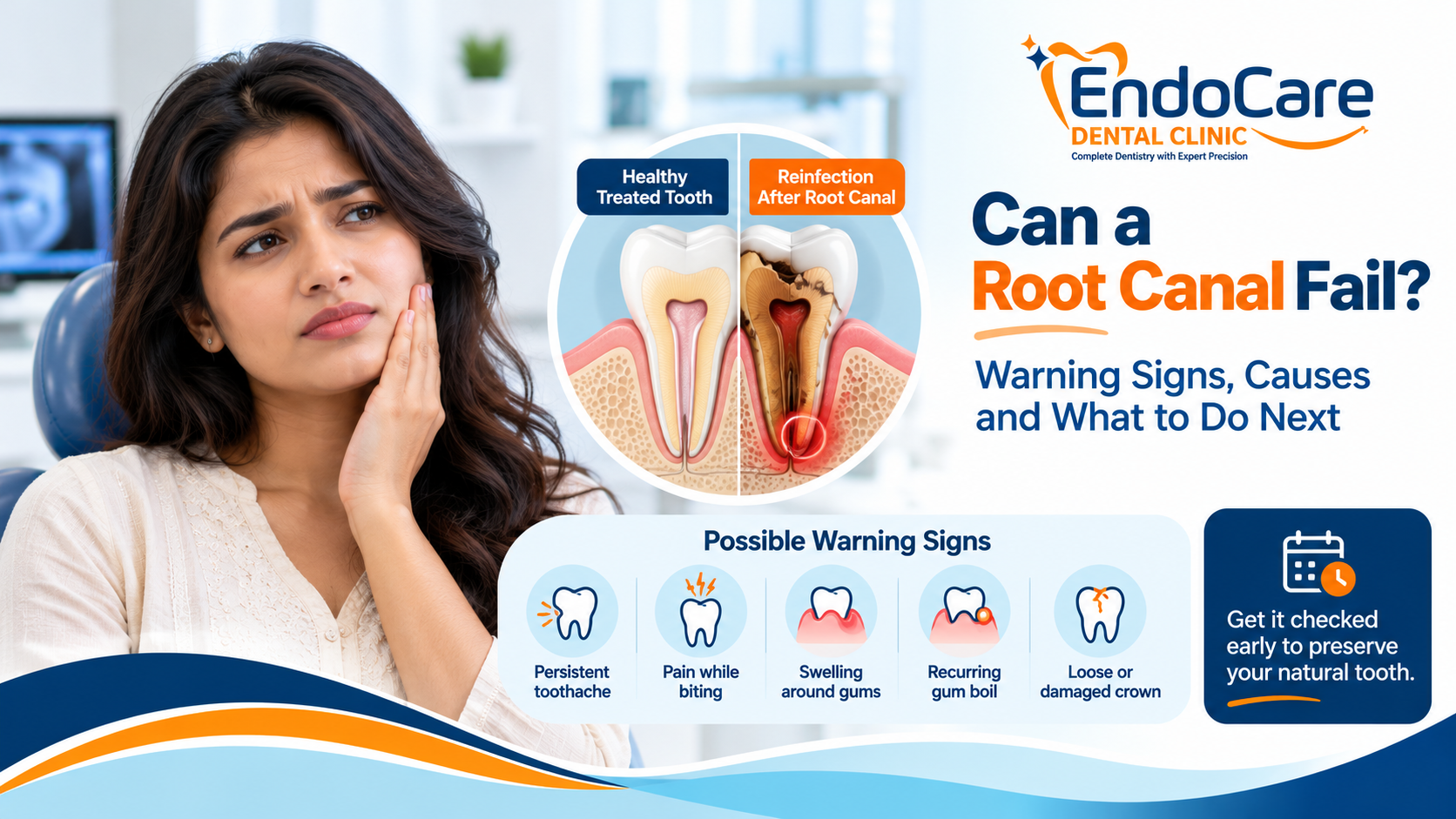
A root canal treatment is designed to remove infection from inside a tooth, relieve pain and help preserve your natural tooth. However, some patients experience toothache, sensitivity, swelling or discomfort months or even years after the procedure. This can raise an important question: Can a root canal fail?
Yes, a root canal can sometimes fail or develop a new infection. This does not necessarily mean the original treatment was performed incorrectly. Complex root canal anatomy, persistent bacteria, a leaking restoration, a damaged crown or a new crack in the tooth can contribute to problems later.
If you are experiencing root canal pain years after treatment, it is important to identify the cause rather than ignore the symptoms. At EndoCare Dental Clinic in Viman Nagar, Pune, Dr. Mugdha Bichile Pimplapure (BDS, MDS), Conservative Dentist and Microscopic Endodontist, evaluates dental problems and helps patients understand suitable treatment options.
Read on to learn about failed root canal symptoms, possible causes, retreatment and when you should consult a root canal specialist in Viman Nagar, Pune.
In This Article
Can a Root Canal Treatment Fail? {#can-a-root-canal-treatment-fail}
Yes. Although root canal treatment has a high success rate, a treated tooth can occasionally develop persistent or recurrent infection, inflammation or structural damage.
During root canal treatment, the infected or inflamed pulp is removed from inside the tooth. The root canals are cleaned, disinfected and filled, and the tooth is restored to help protect it from further damage.
Problems may develop if bacteria remain in a complex canal, enter the tooth again through a defective restoration, or reach the tissues around the root through a crack or other pathway.
It is important to understand that a root canal that becomes painful later has not automatically failed. Some symptoms may be caused by a high filling, gum disease, a cracked tooth or another dental condition. A dental examination and appropriate investigations are needed to determine the actual cause.
If you want to understand the procedure first, read our guide to Root Canal Treatment in Viman Nagar, Pune. Replace this link with the verified root canal treatment page URL before publishing if the dedicated page has a different address.
Warning Signs of Root Canal Failure {#warning-signs-of-root-canal-failure}
Recognising possible signs of root canal failure can help you seek timely dental care. Watch for the following symptoms, particularly if they are persistent, recurring or getting worse.
1. Persistent or recurring toothache
Pain that continues beyond the expected recovery period or returns after months or years deserves assessment. The discomfort may be noticeable while chewing or biting, or it may occur spontaneously.
2. Pain when biting or chewing
A root canal-treated tooth that hurts when you bite may have inflammation around the root, a restoration that is too high, a crack or another problem. Your dentist can check the bite and examine the tooth to identify the likely cause.
3. Swelling around the tooth or gums
Swelling near a previously treated tooth can indicate infection or inflammation. A pimple-like bump on the gum, sometimes accompanied by discharge, may also require investigation.
4. A recurring gum boil or discharge
A small bump on the gum that repeatedly appears near a treated tooth may be associated with a draining dental infection. Even if the pain decreases when the bump drains, the underlying cause may still need treatment.
5. A loose, broken or damaged crown
A damaged crown, loose filling or gap around a restoration may allow bacteria to enter the tooth. A restoration problem does not always mean the root canal itself has failed, but it should be assessed promptly.
6. Darkening of the tooth
A tooth can change colour after root canal treatment for several reasons. Discolouration alone does not prove that the treatment has failed, but it can be discussed with your dentist, particularly if other symptoms are present.
7. An infection detected on an X-ray
Sometimes a tooth has few or no obvious symptoms, but a dental X-ray shows a persistent or new area of inflammation around the root. Your dentist may recommend monitoring or further treatment depending on the findings and your clinical history.
Important: Facial swelling, fever, rapidly worsening pain or difficulty opening your mouth requires urgent dental assessment. Difficulty breathing or swallowing, or rapidly spreading swelling, requires emergency medical care.
Why Does a Root Canal Fail? {#why-does-a-root-canal-fail}
There is no single cause of root canal failure. Several factors can contribute to persistent infection or problems developing after treatment.
1. Complex root canal anatomy
Some teeth have narrow, curved or additional canals that can be difficult to locate and clean. If bacteria remain in an untreated or inaccessible area, infection may persist.
2. Persistent bacteria inside the tooth
Bacteria may survive in complex areas of the root canal system despite treatment. In some cases, further treatment is needed to manage the infection.
3. Delay in placing the final restoration
After root canal treatment, the tooth needs an appropriate final restoration. If the tooth remains inadequately sealed or the temporary filling deteriorates, bacteria may re-enter the tooth.
4. A leaking or damaged crown or filling
A cracked crown, broken filling or defective seal can allow saliva and bacteria to enter the treated tooth. This can lead to reinfection and may require restoration repair or replacement.
5. A crack or fracture in the tooth
Root canal-treated teeth can still crack or fracture, particularly when substantial tooth structure has been lost. A crack extending below the gum line may make the tooth difficult or impossible to save.
6. New decay around the restoration
Dental decay can develop around an existing filling or crown. If it reaches the underlying tooth structure, bacteria may gain access to the previously treated area.
7. Problems in the tissues around the tooth
Pain around a treated tooth may arise from gum disease, bite-related trauma or other conditions rather than infection inside the root canal. Correct diagnosis is important because the recommended treatment depends on the cause.
Can a Tooth Get Infected Again Years After a Root Canal? {#can-a-tooth-get-infected-again-years-after-a-root-canal}
Yes. A tooth can develop a new infection months or years after a root canal, even if it initially healed well.
Possible reasons include:
-
A crown or filling that becomes damaged or loses its seal.
-
New decay around the treated tooth.
-
A crack that allows bacteria to enter.
-
Persistent infection that was not fully resolved.
-
Complex canal anatomy that makes complete disinfection difficult.
If you notice toothache, tenderness while chewing, gum swelling or a recurring bump near a previously treated tooth, arrange a dental examination.
Do not assume that every symptom means you need another root canal. Your dentist may examine the tooth, check the restoration and bite, assess the surrounding gums and recommend X-rays or other investigations when indicated.
An early assessment can help determine whether the problem can be managed with a restoration repair, root canal retreatment, another procedure or, in some cases, extraction.
What Happens During Root Canal Retreatment? {#what-happens-during-root-canal-retreatment}
Root canal retreatment is a procedure in which a previously treated tooth is assessed and, when appropriate, treated again to address persistent or recurrent disease.
The exact steps depend on the tooth, its existing restoration, the condition of the roots and the cause of the problem.
Step 1: Examination and diagnosis
Your dentist reviews your symptoms and dental history, examines the tooth and surrounding tissues, and may recommend X-rays or other imaging if clinically necessary.
Step 2: Assessment of the existing restoration
The dentist evaluates the crown or filling and checks for decay, leakage, cracks and bite-related problems. The restoration may need to be removed to access the root canals, depending on the treatment plan.
Step 3: Accessing the root canal system
When retreatment is appropriate, the dentist accesses the previously treated canals. This may involve removing existing filling material and identifying areas that need further cleaning.
Step 4: Cleaning and disinfection
The root canals are cleaned and disinfected to address the suspected source of infection. The procedure may be technically challenging if the canals are narrow, curved, blocked or previously altered.
Step 5: Refilling and sealing the canals
Once the canals have been appropriately managed, they are filled and sealed. The tooth is then restored according to its condition and the treatment plan.
Step 6: Final restoration and follow-up
A suitable filling or crown may be required to protect the tooth. Follow-up examinations help assess healing and identify any continuing problems.
Retreatment is not the right option for every tooth. Depending on the diagnosis, a dentist may discuss other options, including endodontic surgery or extraction.
For more information about retreatment, consult the American Association of Endodontists' guide to endodontic retreatment.
Can a Failed Root Canal Tooth Be Saved? {#can-a-failed-root-canal-tooth-be-saved}
In many cases, a tooth with persistent or recurrent problems after root canal treatment can still be saved. The best option depends on the cause of the problem and how much healthy tooth structure remains.
Possible treatment options include:
-
Restoration repair or replacement: Suitable when the main issue is a damaged or leaking filling or crown and the root canal does not require further treatment.
-
Root canal retreatment: May be considered when the tooth can be restored and the root canal system needs further treatment.
-
Endodontic surgery: May be an option in selected cases when conventional retreatment is unsuitable or has not resolved the problem.
-
Tooth extraction: May be necessary when the tooth is severely fractured, cannot be restored adequately or has a poor overall prognosis.
Root canal retreatment vs tooth extraction
Saving your natural tooth may help preserve normal chewing function and avoid the need to replace the missing tooth. However, tooth preservation is not always possible, and extraction may be the more appropriate option in certain cases.
Your dentist should explain the benefits, limitations, likely prognosis and costs of each suitable treatment option.
Read our guide to Root Canal Treatment vs Tooth Extraction. Replace this with the verified URL of your dedicated comparison article before publishing.
How to Prevent Root Canal Failure {#how-to-prevent-root-canal-failure}
Although no dental treatment can guarantee lifelong success, good restoration care and regular dental check-ups can help reduce the risk of future problems.
Follow these preventive steps
-
Complete the recommended final restoration: Do not unnecessarily delay a permanent filling or crown if your dentist has advised one.
-
Maintain good oral hygiene: Brush twice daily with fluoride toothpaste and clean between your teeth every day.
-
Attend routine dental check-ups: Regular examinations can help identify decay, restoration damage and other problems early.
-
Avoid chewing very hard objects: Do not use your teeth to bite hard objects, crack nuts or open packaging.
-
Get a damaged crown or filling checked: A loose, cracked or broken restoration should not be ignored.
-
Seek care if symptoms return: Pain, swelling or tenderness around a root canal-treated tooth deserves professional assessment.
The appropriate restoration depends on the amount of remaining tooth structure, the tooth's location, your bite and other clinical factors. Your dentist can recommend what is suitable for your tooth.
When Should You See a Root Canal Specialist? {#when-should-you-see-a-root-canal-specialist}
Consider arranging a dental assessment if you experience:
-
Tooth pain that persists or returns after root canal treatment.
-
Pain or tenderness when biting.
-
Swelling near the treated tooth.
-
A recurring gum boil or discharge.
-
A loose, cracked or damaged crown.
-
A new problem identified on a dental X-ray.
Do not wait for severe pain before seeking help. Some dental infections can progress even when symptoms are mild.
A root canal specialist or appropriately qualified dentist can assess whether the problem is related to the root canal, the restoration, a crack, the gums or another cause. Treatment recommendations should be based on clinical findings rather than symptoms alone.
If you live in Viman Nagar, Kalyani Nagar, Wadgaon Sheri, Kharadi or Dhanori, you can consult a dentist in Viman Nagar, Pune, for an evaluation of a previously treated tooth.
Frequently Asked Questions {#frequently-asked-questions}
1. Can a root canal fail years later?
Yes. A tooth can develop persistent or recurrent infection years after treatment because of new decay, a damaged restoration, a crack or bacteria remaining in a complex root canal system. A dental examination is needed to identify the cause.
2. What are the common symptoms of a failed root canal?
Possible symptoms include recurring toothache, pain while biting, swelling, a gum boil, discharge or a new infection detected on an X-ray. Some teeth have few symptoms, so follow-up examinations can be important.
3. Can a root canal-treated tooth get infected again?
Yes. Bacteria may enter through a damaged or leaking restoration, new decay or a crack in the tooth. Persistent infection can also sometimes remain in complex areas of the root canal system.
4. Can a root canal be done twice on the same tooth?
Yes. A procedure called root canal retreatment may be possible when the tooth can be restored and further treatment is clinically appropriate. Your dentist will assess the tooth and discuss the likely benefits and limitations.
5. Is root canal retreatment painful?
Retreatment is generally performed with local anaesthesia to manage pain during the procedure. Some tenderness or discomfort can occur afterward. Your dentist will provide instructions for managing recovery and explain what symptoms require review.
6. Is retreatment better than tooth extraction?
Neither option is automatically better for every patient. Retreatment may help preserve a restorable natural tooth, while extraction may be necessary if the tooth is severely fractured or cannot be restored. The decision depends on the diagnosis, prognosis, cost and your preferences.
7. How much does root canal retreatment cost in Viman Nagar, Pune?
The cost depends on the tooth involved, the complexity of the canals, the existing restoration, the need for additional procedures and the final crown or filling. An examination is needed to provide an appropriate estimate. Contact EndoCare Dental Clinic for current consultation and treatment charges.
8. Should I worry if my root canal tooth hurts when I bite?
Pain while biting should be assessed, particularly if it is persistent or worsening. Possible causes include a high restoration, inflammation around the root, a crack or infection. Avoid diagnosing the problem yourself and arrange a dental examination.
9. Can antibiotics cure a failed root canal?
Antibiotics alone generally do not remove the source of infection inside a tooth. They may be indicated in certain situations, such as when there are signs of spreading infection or systemic involvement, but the dentist must determine the appropriate treatment. Do not take leftover antibiotics or self-medicate.
10. Can a tooth with a failed root canal always be saved?
No. Some teeth can be treated with retreatment or other procedures, but a severely fractured or unrestorable tooth may need extraction. A clinical examination and appropriate imaging help determine the available options.
Root Canal Retreatment in Viman Nagar, Pune {#root-canal-retreatment-in-viman-nagar-pune}
Experiencing tooth pain, swelling or discomfort after a previous root canal? Do not ignore recurring symptoms or assume that extraction is your only option.
At EndoCare Dental Clinic in Viman Nagar, Pune, Dr. Mugdha Bichile Pimplapure (BDS, MDS), Conservative Dentist and Microscopic Endodontist, provides dental assessment and treatment planning for patients with root canal-related concerns.
The clinic offers comprehensive dental care, including root canal treatment, dental fillings, crowns and bridges, tooth extraction and other restorative and preventive dental services. Treatment recommendations are based on the condition of the tooth and individual clinical findings.
Book a dental consultation if you have:
-
Tooth pain that returns after a root canal.
-
Swelling or tenderness around a previously treated tooth.
-
Pain while chewing.
-
A broken or loose crown or filling.
-
Questions about root canal retreatment versus extraction.
EndoCare Dental Clinic
Address: Near Datta Mandir Chowk, Parijat Mithai Building, 1st Floor, Sai Apex, Viman Nagar Road, Viman Nagar, Pune – 411014
Phone: +91 90968 82602
Hours: Open all 7 days, 10:00 AM–9:00 PM
Serving patients from Viman Nagar and nearby areas, including Kalyani Nagar, Wadgaon Sheri, Kharadi and Dhanori.
Visit EndoCare Dental Clinic's website | Call +91 90968 82602
Medical disclaimer
This article is intended for general educational purposes and does not replace a clinical dental examination, diagnosis or personalised treatment advice. If you have persistent pain, swelling or other symptoms after root canal treatment, consult a qualified dental professional.
This article is general information from the EndoCare Dental Clinic team. It is not a diagnosis or a substitute for an examination by your dentist. Please consult a dentist for advice about your own teeth.